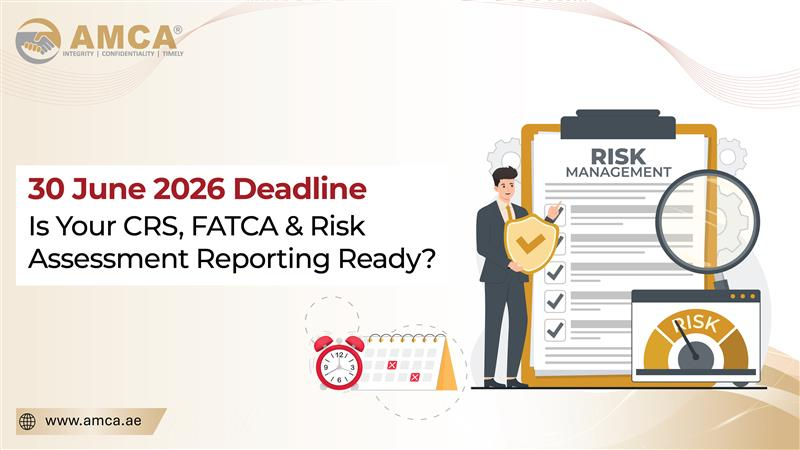
Many UAE Reporting Financial Institutions are now preparing for their CRS and FATCA reporting obligations for the financial year/reporting period from 1 January 2025 to 31 December 2025. The UAE Ministry of Finance (MoF), through the Automatic Exchange of Information (AEOI) framework, has opened the reporting window, and all required CRS and FATCA submissions, including annual returns, nil filings, and the mandatory Risk-Based Assessment, must be completed by 30 June 2026.
These reporting obligations arise under the UAE’s implementation of the OECD Common Reporting Standard (CRS) for the automatic exchange of financial account information and the UAE–United States Intergovernmental Agreement (IGA) for compliance with the Foreign Account Tax Compliance Act (FATCA). Reporting Financial Institutions are required to comply with the reporting, due diligence, and risk assessment requirements prescribed by the UAE Ministry of Finance, the competent authority responsible for administering CRS and FATCA obligations in the UAE through the AEOI framework.
Meeting the deadline is not simply about filing reports. Reporting entities are expected to maintain accurate due diligence records, correctly identify reportable accounts, and demonstrate effective compliance controls in line with CRS and FATCA requirements.
Why CRS & FATCA Reporting Gets Delayed
CRS and FATCA reporting often gets delayed due to incomplete customer due diligence records, incorrect classification of reportable accounts, overlooked nil filing obligations, and last-minute preparation of the mandatory Risk-Based Assessment. Since reporting requires a thorough review of customer information and internal records, addressing these requirements early can help Reporting Financial Institutions avoid compliance risks and meet the 30 June 2026 deadline efficiently.
The Most Common Compliance Mistakes
Certain errors can increase regulatory risk and lead to compliance concerns.
-
Missing the 30 June 2026 reporting deadline.
-
Failing to maintain adequate internal controls and governance over CRS and FATCA compliance.
-
Not conducting periodic reviews of existing account holders to identify changes in circumstances.
-
Inadequate monitoring of reporting obligations across multiple jurisdictions.
-
Failing to complete and document the mandatory Risk-Based Assessment as required by the UAE Ministry of Finance.
How Weak Compliance Controls Increase Risk
Effective CRS and FATCA compliance depends on strong internal procedures, documentation, and ongoing monitoring. Weak compliance controls can lead to inaccurate account classifications, incomplete supporting records, inadequate risk assessments, and reporting errors.
These shortcomings often result in:
-
Penalties and fines for non-compliance with reporting obligations.
-
Increased regulatory scrutiny from the UAE Ministry of Finance and relevant authorities
-
Delays in meeting reporting requirements and addressing compliance issues.
-
Reputational damage that may affect stakeholder, investor, and customer confidence.
Maintaining robust compliance controls helps Reporting Financial Institutions identify risks early and meet their CRS and FATCA obligations with greater confidence.
Steps to Ensure Timely Compliance
• Review your CRS and FATCA reporting obligations for the 2025 reporting period.
• Verify customer due diligence documentation and account classifications.
• Validate reportable account information.
• Complete the Risk-Based Assessment for the financial year ended 31 December 2025.
• Submit all required filings before 30 June 2026.
Need Help with CRS & FATCA Reporting? AMCA Can Assist
AMCA supports Reporting Financial Institutions with CRS and FATCA compliance reviews, due diligence assessments, Risk-Based Assessment preparation, and filing support.
Contact AMCA today to ensure your reporting obligations for the financial year 1 January 2025 to 31 December 2025 are completed accurately and submitted before the 30 June 2026 deadline.
Phone: +971 4 321 1204
Email: info@amca.ae
Website: www.amca.ae


.jpg "Complete Tax & Compliance Outsourcing UAE: One Package for Taxation and AML")
.jpg "Most Businesses Get Fined for This in UAE: Common Compliance Mistakes Explained")
.jpg "SPV vs Holding Company UAE: Which Structure Is Better for Tax & Compliance?")